Spinal Decompression
Spinal Decompression vs Traction: Key Differences
August 17, 2026
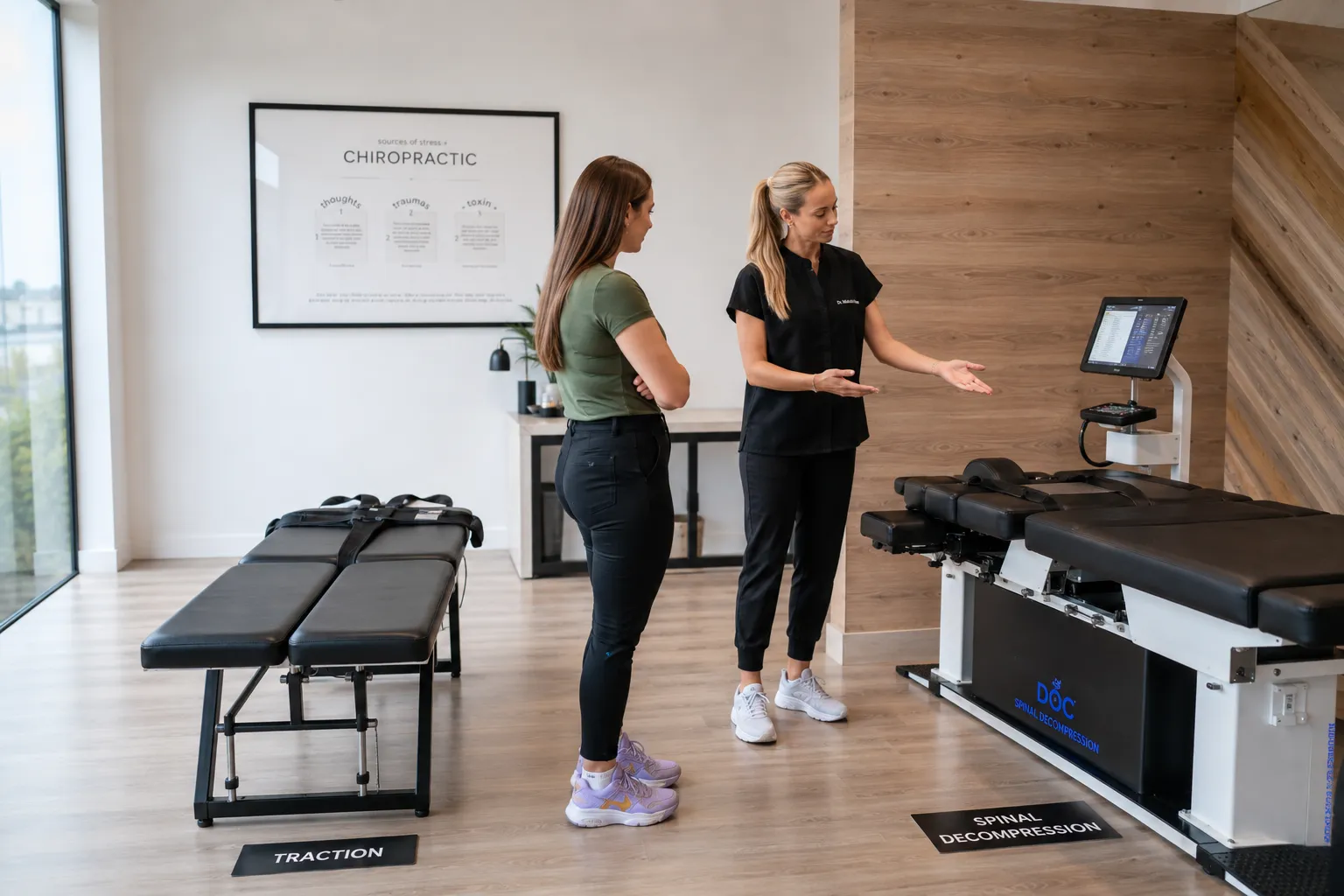
If you've been researching treatment for back pain, you've probably seen both traction and spinal decompression recommended. They sound similar, and some clinics even use the terms interchangeably, but they're not the same treatment. The differences could influence which treatment your provider recommends and what results you can realistically expect.
Key Takeaways
- Traction and spinal decompression are different treatments, even though the terms are often used interchangeably.
- Traction uses a general pulling force, while spinal decompression uses computer-controlled movements designed to target specific spinal discs and nerves.
- Current research suggests both treatments may help certain patients, but there isn't enough evidence to conclude that one is consistently more effective than the other.
- The most appropriate treatment depends on the underlying cause of your back pain, which is why a proper evaluation is important.
What's Really Happening When Your Back Hurts?
Structural changes such as disc degeneration, spinal misalignment, or nerve compression can develop gradually over months or even years before symptoms appear. In fact, studies have shown that many people have disc bulges or degeneration visible on imaging without experiencing any pain at all. The opposite can also happen: significant pain may develop even when structural changes appear relatively minor.
The reverse is just as important. You might feel better after a few sessions of stretching, heat therapy, or other conservative treatments, but that doesn't necessarily mean the underlying problem has resolved. Pain relief and structural healing aren't always the same thing, which is why symptoms sometimes return weeks or months later.
Why do symptoms disappear before the problem is actually fixed?
Your body is remarkably good at adapting. Muscles compensate, inflammation settles, and pain signals become less noticeable over time. That can happen even if a disc is still placing pressure on a nerve or the spine hasn't returned to its ideal alignment. Without objective measurements, such as imaging or other clinical assessments, it's easy to assume the problem is gone when the source of the pain is still there.
Is traction the same thing as spinal decompression?
No. Traction and spinal decompression are different treatments with different goals. Traction uses a general pulling force to stretch the spine, while spinal decompression uses computer-controlled movements designed to target specific spinal discs and nerves.
Here's a simple way to think about it:
- Traction: A broad stretching force applied to the spine.
- Spinal decompression: A controlled, targeted treatment designed for specific disc and nerve-related conditions.
Choosing the wrong option based on assumed similarity wastes time chasing symptom relief instead of addressing what's actually causing the pain.
How Does Traction Differ From Spinal Decompression?
Medical terminology draws a sharp line between these two therapies. Traction simply describes the action of applying a pulling force to the spine. Spinal decompression, on the other hand, refers to relieving pressure on a spinal nerve. While non-surgical spinal decompression takes its name from this clinical goal, it uses computer-controlled movements to target specific spinal discs and nerves rather than applying a general stretch.
For someone dealing with chronic back pain, sciatica, or a herniated disc, that difference matters. A treatment described as "traction" may stretch the spine without specifically targeting the source of nerve compression that's causing the pain.
Why does this distinction matter for choosing care?
It's easy to assume that treatments with similar names do the same job, but that's not always the case. Traction and spinal decompression may both involve stretching the spine, yet they're designed with different goals in mind.
Rather than focusing on the name of the treatment, ask what it's intended to achieve. Is the goal simply to stretch the spine, or to reduce pressure on a specific disc or nerve? That conversation can help you choose the treatment that's best suited to your condition.
Does Research Show One Therapy Works Better?
The short answer is not yet.
A small number of studies have compared traditional motorized traction with non-surgical spinal decompression in people with chronic low back pain caused by lumbar disc disease. While both treatments have been shown to help reduce pain and improve function, there's currently not enough high-quality research to say that one is consistently better than the other.
That means treatment decisions shouldn't be based on marketing claims alone. Your symptoms, diagnosis, and the cause of your back pain all play an important role in determining which approach is most appropriate.
How do researchers measure which treatment works?
Rather than relying on patient opinions alone, researchers use established assessment tools to measure whether treatment is making a meaningful difference.
The most common include:
- Visual Analog Scale (VAS): Measures how severe a person's pain is before and after treatment.
- Oswestry Disability Index (ODI): Measures how back pain affects everyday activities such as walking, sleeping, sitting, and working.
These tools help researchers evaluate two important parts of recovery:
- Pain levels: Whether pain becomes less severe over time.
- Daily function: Whether patients are able to move more comfortably and return to normal activities such as driving, picking up their kids and working on a computer.
Is the research on this comparison extensive?
Only a limited number of studies have directly compared motorized traction with non-surgical spinal decompression, making it difficult to conclude that one treatment is universally more effective than the other.
For patients, that's an important takeaway. Rather than assuming one treatment works best for everyone, the focus should be on finding the approach that matches your diagnosis, symptoms, and treatment goals. A thorough assessment is often more valuable than choosing a therapy based on its name alone.
How Can You Confirm Your Spine Is Actually Improving?

One of the biggest challenges in treating back pain is knowing whether you're actually improving or simply having a good week. Pain can change from day to day because of inflammation, activity levels, stress, or muscle tension, so it doesn't always reflect what's happening inside the spine.
And for this reason, Elite Wellness Chiropractic uses before-and-after digital X-rays alongside symptom tracking. Your first X-ray establishes a baseline, and follow-up images are compared against it throughout your treatment. This allows your provider to see whether there have been measurable changes in spinal alignment, rather than relying on pain levels alone.
What do X-rays actually reveal about a herniated or bulging disc?
Digital X-rays help evaluate spinal alignment, posture, curvature, and other structural changes that may be contributing to pain or restricted movement. Combined with your symptoms and physical examination, they give your provider a clearer picture of what's happening and whether your treatment plan is moving in the right direction.
Why not just judge progress by pain levels?
Pain is only one part of the picture. You may feel better because inflammation has settled or your muscles have adapted, even though the underlying spinal issue still needs attention. The opposite can also happen: some people continue to experience pain while their spine is making measurable progress.
Looking at both your symptoms and follow-up X-rays gives your provider a more complete view of how you're responding to treatment.
Where Can Bee Cave Patients Get Corrective Care?
If you're looking for non-surgical care for chronic back pain, sciatica, or a herniated disc, Elite Wellness Chiropractic provides corrective chiropractic care and spinal decompression therapy for patients in Bee Cave and the surrounding communities.
Our clinic focuses on identifying and treating the underlying cause of spinal pain rather than simply managing symptoms. Treatment recommendations are tailored to each patient's condition, with the goal of improving spinal function and supporting long-term recovery.
More than 411 five-star Google reviews reflect the experiences of patients who have chosen Elite Wellness Chiropractic for their care. While every patient's results are different, those reviews highlight the clinic's commitment to personalized treatment and patient outcomes.
How Does Treatment Get Personalized for Each Patient?
Your first appointment is a consultation where your provider takes the time to understand what's causing your symptoms. We’ll discuss your pain, review any previous imaging or test results you've had, perform a thorough examination, and determine whether spinal decompression, corrective chiropractic adjustments, or a combination of treatments is the most appropriate approach.
No two cases of back pain are exactly alike. Someone with a bulging disc may need a different treatment plan than someone experiencing chronic sciatica, spinal stenosis, or recurring lower back pain. That's why recommendations are based on your diagnosis, symptoms, and examination findings.
What Should Patients Expect at Their First Visit?
Consultations are designed to build a clear picture of your spinal health before any treatment recommendations are made. During your visit, your provider may discuss:
- Your current symptoms and when they started
- Previous imaging or diagnostic test results, if available
- Your medical history and any previous treatments
- Daily activities or lifestyle factors that may be contributing to your pain
- Whether spinal decompression, chiropractic adjustments, or another treatment approach is likely to benefit your condition
This appointment also gives you the opportunity to ask questions, discuss your treatment options, and better understand what's causing your symptoms before deciding on a long-term care plan.
FAQ
Is spinal decompression the same as traction?
No. Although the terms are often used interchangeably, they describe different treatments. Traction uses a general pulling force to stretch the spine, while spinal decompression uses computer-controlled movements designed to reduce pressure on spinal discs and nerves.
Does traction have a formal medical definition?
Traction is a general term for applying a pulling force to the spine or another part of the body. Spinal decompression, by contrast, refers to relieving pressure on spinal discs and nerves through a more targeted treatment approach.
Why does back pain sometimes return after treatment feels successful?
Feeling better doesn't always mean the underlying cause of your back pain has fully resolved. As inflammation settles and muscles adapt, pain may improve even if the spine is still healing. For this reason, healthcare providers often look at both your symptoms and your progress over time when evaluating how well a treatment is working.

Dr. Mikala Hiben
Chiropractor and Owner at Elite Wellness Chiropractic
Featured Articles

10 Posture Tips for Residents of Bee Cave, Texas
Improve your posture with these 10 practical tips from Elite Wellness Chiropractic in Bee Cave. Simple daily changes for better spinal alignment and less pain.
10 Posture Tips for Residents of Bee Cave, Texas

What to Expect at Your First Chiropractic Visit in Bee Cave
Wondering what happens at your first chiropractic appointment? Here's a clear walkthrough of the consultation, exam, X-rays, costs, and how to prepare for your visit at Elite Wellness Chiropractic in Bee Cave.
What to Expect at Your First Chiropractic Visit in Bee Cave

Unlock Lasting Relief for Tech Neck: Beyond Temporary Fixes
Struggling with tech neck? Learn how corrective chiropractic care at Elite Wellness in Bee Cave can relieve neck pain, improve posture, and restore lasting comfort.
Unlock Lasting Relief for Tech Neck: Beyond Temporary Fixes