Google Reviews
Degenerative Disc Disease Treatment in Bee Cave, TX
A degenerative disc disease diagnosis can leave you with more questions than answers, especially when your back still hurts and you’re not sure what the MRI findings actually mean. At Elite Wellness Chiropractic in Bee Cave, Dr. Mikala Hiben, DC, uses corrective chiropractic care and DOC decompression to address the alignment and movement issues that may be contributing to your symptoms.
Key Takeaways: What You Need to Know About Degenerative Disc Disease
- Seeing degeneration on an MRI doesn't automatically mean something is wrong. Disc changes are incredibly common as we get older, and plenty of people have them without any back pain. One review of more than 3,100 people found signs of disc degeneration in 37% of people in their 20s, 68% of people in their 40s, and more than 90% of people over 60 (Brinjikji et al., 2015).
- Your MRI isn't the whole story. A worn or thinner disc doesn't necessarily explain why your back hurts. Changes around the disc, including inflammation, reduced disc height, joint stress, or irritation around a nerve, can have more to do with the symptoms you're actually feeling.
- Chiropractic care is one non-drug option for chronic low back pain. The American College of Physicians includes spinal manipulation among its recommended non-drug treatments for chronic low back pain (Qaseem et al., 2017).
- Decompression is designed to take pressure off the affected area. Research has found that controlled spinal decompression can create negative pressure within the disc space. At Elite Wellness Chiropractic, DOC decompression is used alongside corrective chiropractic care rather than as a standalone treatment.
- Some symptoms shouldn't wait for a chiropractic appointment. New problems with bladder or bowel control, numbness around the groin or inner thighs, or worsening weakness in both legs can point to a serious spinal problem. Those symptoms need emergency medical attention.
What’s Actually Happening to Your Spine?
“Degenerative disc disease” sounds a lot more alarming than it often is. The name describes changes that happen to the discs between the bones of your spine as they lose water, become thinner, and develop small changes over time. It also doesn’t automatically mean those changes are the reason your back hurts.
That last part is important. An MRI can show disc degeneration even when a person has no pain at all. A review of MRI scans from 3,110 people without back pain found signs of disc degeneration in 37% of people in their 20s, 68% of people in their 40s, and more than 90% of people over 60 (Brinjikji et al., 2015).
So why can one person have disc degeneration without a problem while another ends up dealing with persistent back pain?
The disc changes matter, but the way your spine responds to those changes matters too!
Genetics can also play a bigger role than you might expect. Research from the Twin Spine Study found that genetic factors accounted for 47% to 66% of the variation in disc degeneration, while physical loading from work accounted for much less (Battie et al., 2009). So having disc degeneration doesn't necessarily mean you somehow “wore out” your spine.
And then there's everyday life. Living around Bee Cave and the Hill Country often means staying active, whether that's running at Reimers Ranch, cycling around Hamilton Pool Road, or commuting into Austin. Those activities aren't inherently bad for your back, but repetitive loading can become harder to tolerate when the spine is already dealing with structural changes.
The goal isn't to panic over what's written on an MRI report. It's to figure out whether those changes actually line up with your symptoms and how your spine is moving.
Signs, Symptoms & When to Pay Attention
Back pain can look different from person to person. With degenerative disc disease, symptoms can depend on which discs are affected and whether nearby nerves are being irritated.
Common Symptoms
- A deep, aching pain in the lower back that gets worse after sitting, bending, or lifting
- Stiffness in the morning or after you've been sitting or inactive for a while
- Back pain that eases when you walk, move around, or change positions
- Flare-ups that can stick around for several days or even weeks before settling down
- A feeling that your back is “catching” or “locking” during certain movements
Signs a Nerve May Be Involved
- Pain that travels from your lower back into your buttock, thigh, or leg
- Numbness or tingling in your leg, foot, or toes
- Weakness when lifting your foot or pushing off with your toes
- Pain that gets worse when you cough, sneeze, or strain
Not Every MRI Finding Tells the Whole Story
Your MRI might show disc degeneration, but that doesn't tell you everything about why you're hurting. Research by de Schepper et al. (2010) found that things like narrowing between the discs and bone growth were more closely linked with symptoms than some of the signal changes seen on an MRI.
That’s why your symptoms matter just as much as the scan.
Pain that stays mostly in your lower back and changes with movement or position may point toward a problem that can often be approached with conservative care, including chiropractic treatment and decompression. Pain that travels into your leg, especially when it comes with numbness, tingling, or weakness, deserves a closer look to see whether a disc herniation or narrowing around a nerve is also involved.
When Back Pain Needs Urgent Medical Attention
Some back pain can be evaluated during a regular appointment. Certain symptoms shouldn't wait.
Go to an emergency department right away if you develop:
- New problems controlling your bladder or bowels
- Numbness around your inner thighs, groin, or genital area
- Weakness developing in both legs over a short period
- Severe back pain accompanied by fever, chills, or unexplained weight loss
- New neurological symptoms after a significant injury
When Should You Contact the Office?
Not every symptom requires an emergency room visit, but persistent or new symptoms are worth getting checked rather than hoping they'll eventually disappear (as they say, rather be safe than sorry).
Contact the office within 24 to 48 hours if you notice:
- New or worsening numbness or tingling in a leg or foot
- Muscle weakness that wasn't there before
- Pain that repeatedly wakes you up at night
- Symptoms that haven't improved after 4 to 6 weeks of self-care
What Does the Research Say?
The research on chiropractic care for low back pain is encouraging, but it isn't a promise that every person will have the same result. Studies have looked at spinal manipulation, exercise, and decompression, with several finding improvements in pain and physical function.
Here’s what some of that research has found:
Spinal Manipulation for Low Back Pain
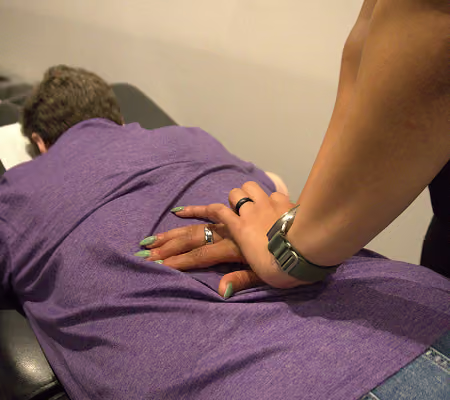
The American College of Physicians lists spinal manipulation as one of the non-drug treatment options for chronic low back pain. That recommendation was based on moderate-quality clinical evidence (Qaseem et al., 2017).
A 2017 review in JAMA looked at 26 randomized controlled trials and found that spinal manipulation improved pain and physical function in people with acute low back pain. The review did not report serious adverse events (Paige et al., 2017).
A Cochrane review also found improvements in pain and function with spinal manipulative therapy for chronic low back pain. The strongest results were seen when care was combined with exercise (Rubinstein et al., 2011).
What About Decompression?
Research on spinal decompression has looked at what happens to pressure inside the discs during treatment. Ramos and Martin (1994) found that vertebral axial decompression created negative pressure within spinal discs, which may help with fluid and nutrient movement.
A later review by Macario and Pergolizzi (2006) reported reductions in pain among patients receiving motorized spinal decompression for chronic disc-related low back pain, with some reported benefits continuing for several months.
EVIDENCE-BASED OUTCOMES
A Few Numbers Worth Knowing
of patients in one study improved within 2 weeks
Pengel et al., 2003
average pain reduction on a 100-point scale in one review
Paige et al., 2017
Serious events were rare, estimated at about 1 in 1 to 2 million treatments
Haldeman et al., 1999
American College of Physicians Guideline
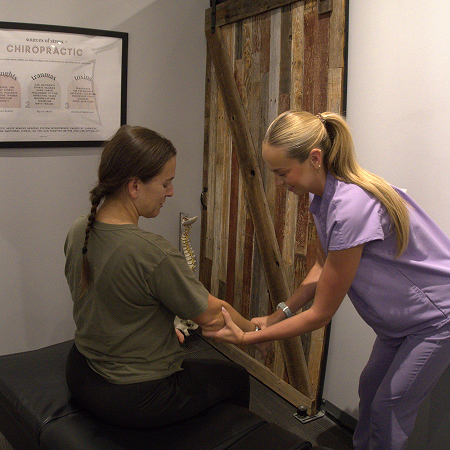
Qaseem et al. (2017) published a landmark guideline recommending spinal manipulation as a first-line, non-drug treatment for chronic low back pain. The recommendation received a strong rating based on moderate-quality clinical evidence.
JAMA Meta-Analysis
Paige et al. (2017) reviewed 26 randomized controlled trials and found spinal manipulation significantly improved both pain and physical function in patients with acute low back pain. No serious adverse events were reported.
Cochrane Review Evidence
Rubinstein et al. (2011) analyzed multiple randomized trials and concluded that spinal manipulative therapy improves pain and function compared to placebo, with the best long-term outcomes achieved when combined with exercise.
Best Evidence Synthesis
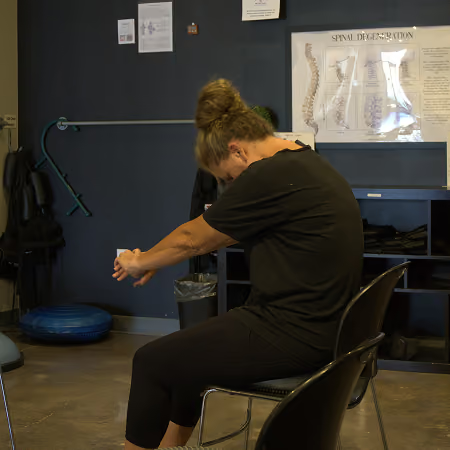
Bronfort et al. (2004) reviewed 43 randomized controlled trials and found moderate evidence supporting spinal manipulation for chronic low back pain. The greatest improvements occurred when treatment was paired with strengthening exercises.
Spinal Decompression Research
Ramos & Martin (1994) demonstrated that spinal decompression creates negative pressure inside spinal discs, helping improve hydration and nutrient delivery. Later evidence from Macario & Pergolizzi (2006) also reported meaningful pain reduction with benefits lasting up to six months.
How EWC Approaches Degenerative Disc Disease
Dr. Mikala Hiben, DC, doesn't look at a diagnosis and stop there. She looks at how your spine is moving, what your imaging shows, and how your symptoms fit together. The goal is to figure out where your spine is struggling and build care around what you actually need.
Start With a Closer Look
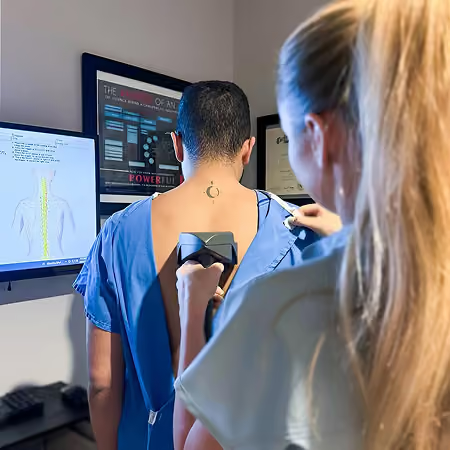
Every new patient starts with an examination and digital X-rays when clinically appropriate. Dr. Hiben looks at your spinal alignment, mobility, posture, disc health, and neurological function before recommending a treatment plan.
DOC Decompression
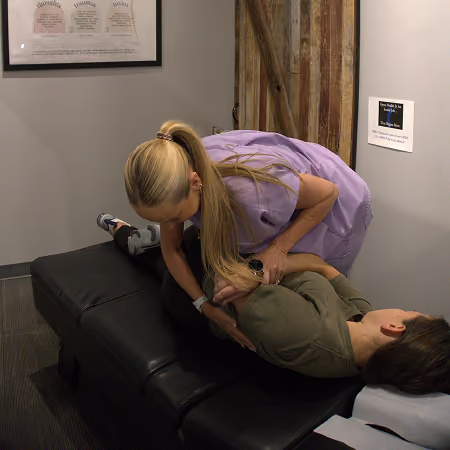
DOC decompression uses controlled, targeted movement to reduce pressure around the affected area of the spine. The table can be adjusted to position the spine in different ways, allowing treatment to focus on the disc level being addressed.
A Plan Built Around You
There isn't one treatment schedule that works for every case. Your recommended care is based on your examination and imaging, including where the degeneration is located and how it's affecting your movement.
Targeted Chiropractic Care
Chiropractic adjustments can help restore movement in restricted joints and reduce mechanical stress on the spine. For someone who needs a gentler approach, Activator Method adjustments are also available.
Build Strength and Stability
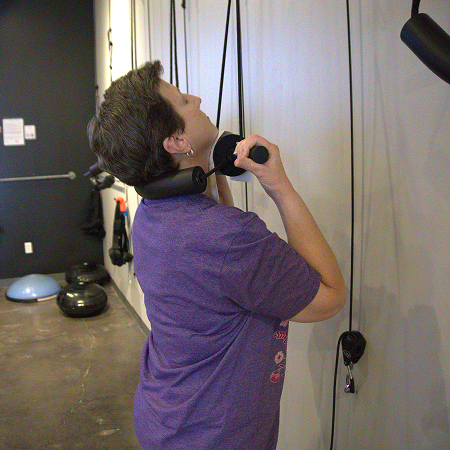
Care isn't just about what happens on the treatment table. Personalized exercises can help build strength, support the spine, and make everyday movement easier as you work through your care plan.
Keep Track of Your Progress
You shouldn't have to guess whether your care is helping. Follow-up visits can include mobility testing, functional measurements, and reassessments so Dr. Hiben can see what's changing and adjust your plan when needed.
What Your Care Looks Like
STEP 01
Find the Source
Your first visit includes a detailed exam and digital X-rays when needed. Dr. Hiben uses what she finds to determine what may be contributing to your symptoms.
STEP 02
Start Corrective Care
Your care plan may include chiropractic adjustments, DOC decompression, and corrective exercises based on what your examination shows.
STEP 03
Build From There
As your movement and symptoms change, your care can change with you. Follow-up assessments help Dr. Hiben see how you're progressing and decide what makes sense for the next stage of care.
Your Recovery Timeline
Every person responds differently, so your schedule may change as Dr. Hiben sees how your body is responding to care. The timeline below gives you an idea of what the first 12 weeks may look like.
Weeks 1 to 4: Getting Started
During the first few weeks, visits are typically 2 to 3 times per week. The focus is on getting your pain under control, improving joint movement, and beginning your decompression and corrective care plan.
Progress milestones
Around week 2, you may notice:
- Less stiffness when you first get up
- Sitting feels more manageable
- Everyday movements don't bother you quite as much
Around week 4, the focus shifts toward:
- Better tolerance for walking and standing
- Less intense pain during normal daily activities
- Fewer flare-ups interfering with your day
Weeks 5 to 8: Building Strength and Movement
As your care progresses, visits typically decrease to 1 to 2 times per week. Decompression may continue while corrective exercises become a bigger part of your plan.
The goal here isn't simply to keep treating the painful area. It's to help you build strength and stability so your spine can handle more of what you want to do.
Progress milestones
Around week 5, you may notice:
- Fewer flare-ups
- More consistent improvement in how you move and function
Around week 6, you may be working toward:
- Getting back to more of your usual activities
- Tolerating moderate exercise again
Weeks 9 to 12: Checking Your Progress
Treatment transitions to maintenance-level care with ongoing corrective exercises. Reassessment at week 12 evaluates structural progress via follow-up imaging if indicated.
Progress milestones
Around week 10:
The focus is on seeing whether your pain and endurance are continuing to improve.
At Week 12:
Dr. Hiben can reassess your progress and determine what makes sense for the next stage of care. Follow-up imaging may be used when clinically indicated.
What This Timeline Doesn't Mean
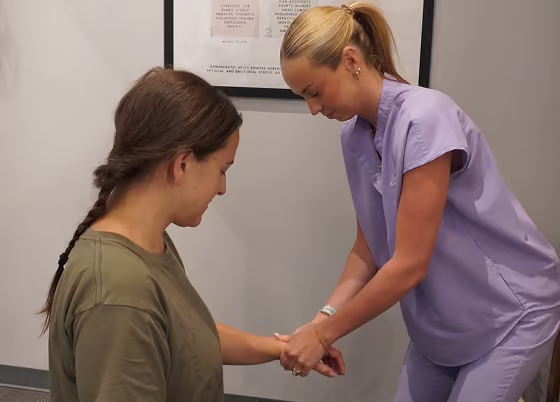
These weeks aren't a promise that you'll feel a certain way by a certain date. Your treatment schedule depends on your symptoms, examination findings, imaging, and how you respond to care.
What Happens After the First 12 Weeks?
Degenerative disc changes don't simply disappear once your initial care is finished. Some patients may benefit from occasional maintenance care, especially when their activity level, symptoms, or spinal findings make it useful.
Dr. Hiben can recommend a maintenance schedule based on how you're feeling, how you're moving, and what your examination shows. The schedule isn't the same for everyone, and it can change over time.
When Chiropractic Care Isn't the Right Choice
Chiropractic care isn't the right approach for every person with degenerative disc disease. Dr. Hiben looks at your history, symptoms, imaging, and overall health before deciding whether corrective care and decompression are appropriate. In some cases, another provider or a combination of treatments may make more sense.
When You May Need a Different Approach
- Severe osteoporosis - Significant bone loss can change which techniques are safe to use. Some patients may need a gentler approach, such as the Activator Method, while others may be better suited to a different type of conservative care. Decompression may also need to be modified or avoided depending on the severity.
- Previous spinal surgery with hardware - Fusion hardware, artificial discs, or other implants near the affected area can affect whether decompression is appropriate. Dr. Hiben looks at the type and location of the hardware before making that decision.
- A large disc fragment - When imaging shows a large piece of disc material that has broken free and entered the spinal canal, a surgical consultation may be needed before trying conservative care.
- Sometimes Another Provider Is Part of the Plan - Needing another type of care doesn't mean chiropractic has failed. Some patients may benefit from working with a pain management specialist or physical therapist alongside chiropractic care.
The important part is figuring out what makes sense for your particular situation.
Relative Contraindications:
- Severe osteoporosis: Patients with significant bone density loss may require modified techniques (such as the Activator method) or may be better served by other conservative approaches. Decompression protocols are also adjusted or contraindicated depending on severity.
- Prior spinal surgery with hardware: Fusion hardware, artificial discs, or other implants at or near the affected level may preclude decompression treatment. Each case is evaluated individually based on the type and location of hardware.
- Large disc sequestrations: If imaging reveals a large free fragment of disc material in the spinal canal, surgical consultation is appropriate before pursuing conservative care.
Common Questions People Ask About Degenerative Disc Disease
Not really. The name makes it sound much scarier than it is.
Degenerative disc disease describes changes that happen to the discs between the vertebrae over time. Those discs naturally lose water and can become thinner as we age. An MRI can show these changes even in someone who has no back pain. In one review, disc degeneration showed up in more than 90% of people over age 60, even though they were not experiencing symptoms (Brinjikji et al., 2015).
What matters is whether those changes are affecting how your spine moves, irritating nearby nerves, or contributing to the pain you're experiencing.
Chiropractic care can't turn a degenerated disc back into a healthy, younger disc. That's not the goal.
Instead, care focuses on the problems that can develop around those disc changes, such as restricted joint movement, mechanical stress, nerve irritation, and compensatory movement patterns. At EWC, corrective chiropractic care and DOC decompression are used to address those issues based on your examination and imaging.
The two approaches aren't exactly the same. Traditional traction uses a steady pulling force, while DOC decompression uses controlled changes in force during treatment.
The DOC table can also position the spine in different ways, including rotation and lateral flexion. This allows treatment to be directed toward a specific area rather than simply applying the same pulling force throughout the session.
There isn't one treatment schedule that applies to everyone. The number of sessions depends on the severity of the disc changes and how many levels of the spine are involved.
Dr. Hiben may recommend 12 or 24 decompression sessions based on the examination and imaging findings. Some patients begin noticing changes within the first few weeks, while more significant progress may take longer.
Spinal decompression is a controlled, non-invasive treatment, but that doesn't mean it's appropriate for every older adult.
Dr. Hiben screens patients before starting decompression and considers factors such as age, bone density, overall health, and previous spinal surgery. Severe osteoporosis, certain spinal hardware, and unstable fractures may make decompression inappropriate.
A DDD diagnosis alone doesn't mean you need surgery. Conservative care, including chiropractic treatment, decompression, and targeted exercise, is generally considered before surgery.
Surgery may become part of the conversation when symptoms haven't improved after an adequate trial of conservative care, when neurological problems are getting worse, or when serious symptoms such as cauda equina syndrome develop. The decision should be based on your symptoms and function, not simply on what appears on an MRI.
Keep moving. Walking is a simple place to start because it keeps the spine moving without the repeated impact of higher-intensity activities.
It's also worth breaking up long periods of sitting, especially if you're sitting in a soft chair or couch that leaves your lower back rounded. Exercises prescribed for you can help build strength around the spine, and staying at a healthy weight and properly hydrated can also support overall disc health.
Still have questions?
What Our Patients Say About Degenerative Disc Disease Relief.
Sarah B.
Google Review
"...One of the best things at her office is the decompression table, which helps create more space when you have a compressed disc. ... Since I’ve been having my sessions on the decompression table the pain in my lower back has been better then it been in probably the last 25 years..."
Joey T.
Google Review
"...I did the decompression (which was wizard-level relief for my spine… seriously felt like my discs finally got a breather)..."
Shannon U.
Google Review
"...As I'd grown older my back and neck had really begun to give me problems with regards to muscle spasms OFTEN on either side of my back or neck, disc compression and much more limited range of motion/movement..."
Related Conditions We Also Treat
Spinal Stenosis
An evaluation and personalized care plan based on your symptoms and spinal findings.
Heading
Have Questions About Your Back?
A degenerative disc diagnosis doesn't tell you exactly why your back hurts or what kind of care makes sense for you. A thorough evaluation can help connect the dots between your symptoms, your movement, and what your imaging shows.
Your $60 New Patient Experience with Dr. Mikala Hiben, DC, is the place to start. You'll get an evaluation to determine what's contributing to your symptoms and whether corrective care is appropriate for you.
Elite Wellness Chiropractic serves patients in Bee Cave, Lakeway, West Lake Hills, Southwest Austin, and surrounding Hill Country communities. Some patients travel from outside Bee Cave for DOC decompression and EWC's corrective approach.
- Adams, M. A., & Roughley, P. J. (2006). What is intervertebral disc degeneration, and what causes it? Spine, 31(18), 2151-2161. DOI
- Battie, M. C., Videman, T., Kaprio, J., Gibbons, L. E., Gill, K., Manninen, H., Saarela, J., & Peltonen, L. (2009). The Twin Spine Study: contributions to a changing view of disc degeneration. The Spine Journal, 9(1), 47-59. DOI
- Brinjikji, W., Luetmer, P. H., Comstock, B., Bresnahan, B. W., Chen, L. E., Deyo, R. A., Halabi, S., Turner, J. A., Avins, A. L., James, K., Wald, J. T., Kallmes, D. F., & Jarvik, J. G. (2015). Systematic literature review of imaging features of spinal degeneration in asymptomatic populations. AJNR American Journal of Neuroradiology, 36(4), 811-816. DOI
- Bronfort, G., Haas, M., Evans, R. L., & Bouter, L. M. (2004). Efficacy of spinal manipulation and mobilization for low back pain and neck pain: a systematic review and best evidence synthesis. The Spine Journal, 4(3), 335-356. DOI
- de Schepper, E. I., Damen, J., van de Pas, S. I. C., Bernsen, R. M. D., Koes, B. W., & Bierma-Zeinstra, S. M. (2010). The association between lumbar disc degeneration and low back pain: the influence of age, gender, and individual radiographic features. Spine, 35(5), 531-536. DOI
- Luoma, K., Riihimaki, H., Luukkonen, R., Raininko, R., Viikari-Juntura, E., & Lamminen, A. (2000). Low back pain in relation to lumbar disc degeneration. Spine, 25(4), 487-492. DOI
- Macario, A., & Pergolizzi, J. V. (2006). Systematic literature review of spinal decompression via motorized traction for chronic discogenic low back pain. Pain Practice, 6(3), 171-178. DOI
- Paige, N. M., Miake-Lye, I. M., Booth, M. S., Beroes, J. M., Mardian, A. S., Dougherty, P., Branson, R., Tang, B., Morton, S. C., & Shekelle, P. G. (2017). Association of spinal manipulative therapy with clinical benefit and harm for acute low back pain: systematic review and meta-analysis. JAMA, 317(14), 1451-1460. DOI
- Qaseem, A., Wilt, T. J., McLean, R. M., & Forciea, M. A. (2017). Noninvasive treatments for acute, subacute, and chronic low back pain: a clinical practice guideline from the American College of Physicians. Annals of Internal Medicine, 166(7), 514-530. DOI
- Ramos, G., & Martin, W. (1994). Effects of vertebral axial decompression on intradiscal pressure. Journal of Neurosurgery, 81(3), 350-353. DOI
- Rubinstein, S. M., van Middelkoop, M., Assendelft, W. J., de Boer, M. R., & van Tulder, M. W. (2011). Spinal manipulative therapy for chronic low-back pain. Cochrane Database of Systematic Reviews, (2), CD008112. DOI