Back Pain
How Sciatica and Disc Problems Are Connected (and What to Do About It)
September 9, 2026
Sciatica affects up to 40% of people at some point in their lives, according to experts. For some, the problem starts with a disc in the lower spine. When a disc herniates and presses on a nearby nerve, the resulting pain can travel from the lower back into the buttock, leg, and even the foot.
That connection matters because sciatica isn't always a problem with the leg itself. The source can be higher up in the spine, where an irritated or compressed nerve is sending pain down its path.
Key Takeaways
- Sciatica is often linked to irritation or compression of a nerve in the lower spine, which can cause pain, burning, tingling, or numbness that travels into the buttock, leg, or foot.
- A herniated disc can contribute to sciatica when its inner material pushes outward and irritates a nearby spinal nerve.
- Disc-related sciatica is more common in adults between 30 and 50, with factors such as smoking, higher BMI, and physically demanding work also associated with greater risk.
- Herniated discs can sometimes shrink naturally over time. Recent research found spontaneous resorption in about 70% of lumbar disc herniations after conservative treatment, although the likelihood varies by the type of herniation.
- Corrective chiropractic care begins with an assessment rather than an adjustment. EWC uses an examination and X-rays to evaluate the spine before recommending a care plan.
- Treatment can include spinal adjustments, corrective exercises, posture and curve correction, and spinal decompression, depending on the patient's findings.
- EWC tracks progress throughout care rather than relying only on whether symptoms feel better from one visit to the next.
- The first EWC visit includes the examination and X-rays, while the findings and recommended care plan are reviewed at the second visit before the first adjustment is performed.
What Really Causes Sciatica and Disc Pain?
Sciatica isn't actually a problem with the leg. The pain can be felt there, but the irritation often starts around the lower spine, where nerves travel into the buttocks and legs.
That can make sciatica confusing. You might feel a sharp pain in your calf, tingling in your foot, or a burning sensation down one leg, while the problem is actually higher up in your back. A herniated disc is one possible reason a spinal nerve becomes irritated or compressed.
What role does a herniated disc play in sciatica?
Your spinal discs sit between the bones of your spine and help absorb the stress of everyday movement. A disc can become damaged or herniated when its soft inner material pushes through a weakened area of its outer layer.
If that happens near a spinal nerve, the disc can irritate or compress the nerve. Because those nerves extend into the leg, the symptoms aren't necessarily felt where the disc problem is located.
That's why someone with a lower-back disc problem might describe pain that shoots through the buttock and down the leg, numbness or tingling in the foot, or discomfort that gets worse with certain movements or positions.
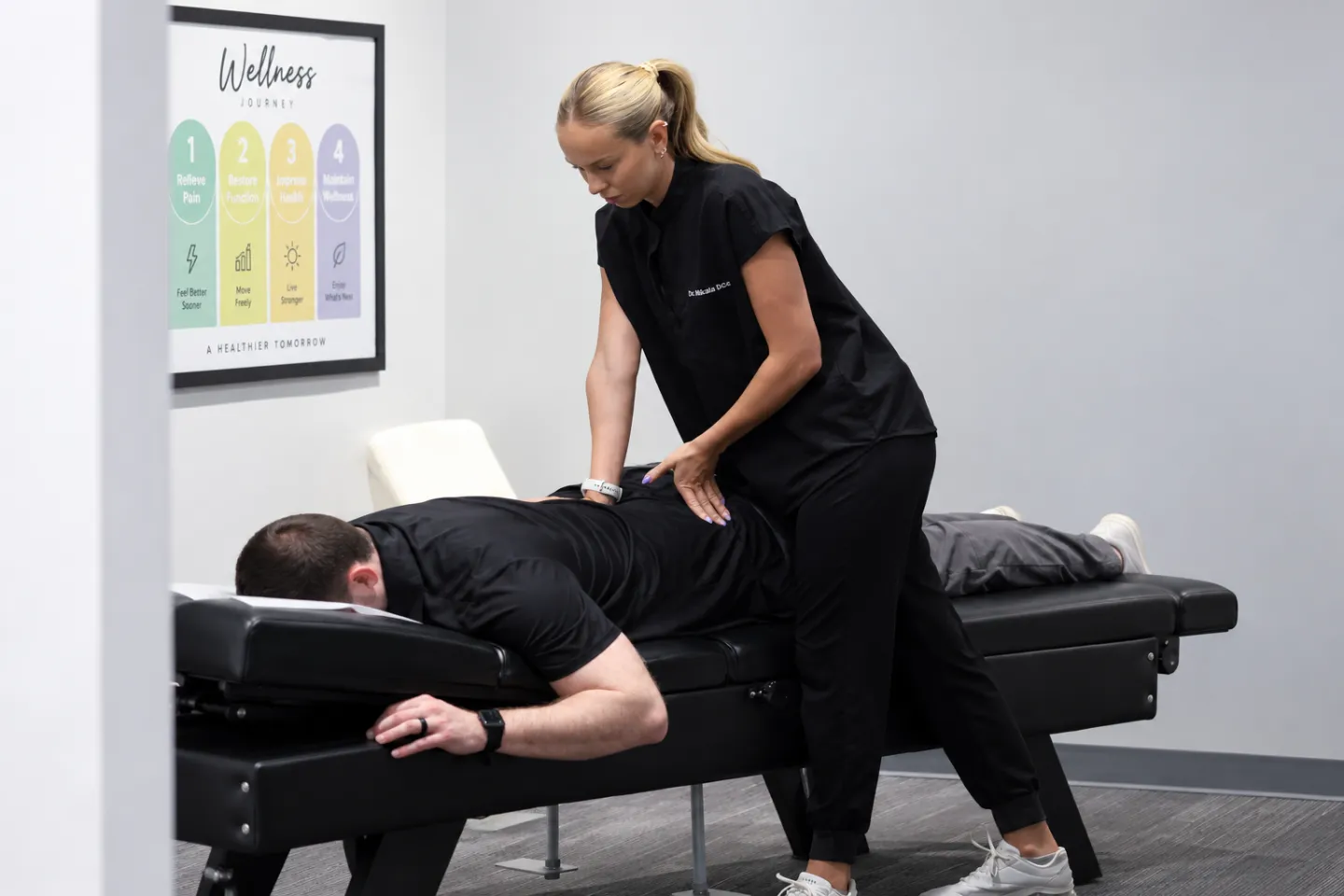
At Elite Wellness Chiropractic, the evaluation doesn't stop at asking where it hurts. Dr. Mikala Hiben, DC, looks at the pattern of symptoms alongside neurological and orthopedic findings, movement, and the areas of the spine that may be contributing to the irritation. This gives the care team more information to work with than the diagnosis of "sciatica" alone.
Why isn't pain relief always the whole answer?
There's an important difference between making pain quieter and figuring out what is keeping it going.
Medication, rest, or other forms of symptom relief can have a place, particularly when pain is making everyday activities difficult. But if the same symptoms keep returning, it makes sense to ask what is happening mechanically and whether something is continuing to irritate the nerve.
That's where EWC's correction vs. compensation philosophy comes into play. Rather than simply working around the symptoms, corrective care looks at the alignment and movement issues identified during the examination and builds treatment around those findings.
We commonly work with patients dealing with:
The point isn't to assume every case of sciatica has the same cause or needs the same treatment. The examination comes first, and the findings help determine what happens next.
Who Is Most Likely to Develop Disc-Related Sciatica?
A herniated disc can happen at almost any age, but it isn't evenly distributed across the population. A 2025 systematic review of 87 studies found that lumbar disc herniation with nerve-related symptoms is most strongly associated with middle age, particularly between 30 and 50. Smoking, higher body weight, and jobs that involve frequent bending or manual lifting were also linked with greater risk.
That lines up with something many working adults experience. Your back may feel fine for years, then a demanding day, awkward lift, or repetitive movement suddenly brings on pain that travels into the leg.
Age is only part of it, though. Genetics, previous back injuries, smoking, body weight, and the physical demands placed on the lower back can all play a role. A 2023 systematic review identified more than 100 potential risk factors for disc degeneration and herniation, including patient, lifestyle, workplace, genetic, and medical factors.
What can cause a disc to herniate?
Sometimes there is a clear moment when symptoms begin. You lift something heavy, twist awkwardly, or get hurt in a car accident, and your back starts hurting soon afterward.
Other times, there is no single event to point to. Repeated bending, lifting, or other physical demands can place cumulative stress on the lower back. Smoking and higher BMI have also been associated with increased risk of lumbar disc herniation with radiculopathy.
And a disc problem doesn't automatically mean you're headed for surgery.
Can a herniated disc get better on its own?
This is one of the more interesting findings in recent disc research: herniated disc tissue can sometimes shrink on its own.
A 2024 meta-analysis of 31 studies involving more than 2,200 patients found that about 70% of lumbar disc herniations showed some degree of spontaneous resorption after conservative treatment. The likelihood varied considerably by the type of herniation. Extruded and sequestered discs were much more likely to shrink than simple bulges.
That doesn't mean every herniated disc will resolve without treatment, or that symptoms should simply be ignored. It does show why a disc diagnosis isn't the end of the story. What matters is how the disc looks, what symptoms you're experiencing, how your nerves are functioning, and how you're progressing over time.
How Does Corrective Chiropractic Care Treat Sciatica in Bee Cave?
If you've already tried chiropractic care for sciatica, you may be wondering what would be different this time. At many chiropractic offices, treatment can mean coming in when you're hurting, getting an adjustment, feeling better for a while, and returning when the pain comes back.
That's not how care is structured at Elite Wellness Chiropractic.
EWC starts with an examination and digital X-rays before any adjustment is made. Dr. Mikala Hiben, DC, uses those findings to assess your alignment, spinal curves, and movement, then explains what the images and exam reveal before recommending a care plan.
That extra step matters when you're dealing with a problem that keeps coming back. Instead of deciding on treatment based only on where you hurt that day, the plan is built around what the examination shows.
How is EWC different from a typical chiropractic visit?
The biggest difference is what happens between the adjustments.
A typical high-volume chiropractic office may focus on getting patients in and out, with treatment centered around the immediate complaint. EWC takes a more structured approach, with a care plan, progress checks, and corrective exercises designed to support changes made during treatment.
The practice is also intentionally small. A four-person team handles care, giving patients more one-on-one attention rather than moving through a high-volume appointment model.
And because EWC is a cash-pay practice, care isn't built around what an insurance plan will approve. Patients receive a defined plan based on their examination and goals. Routine insurance isn't accepted, although auto injury cases are an exception.
What might sciatica treatment include?
There isn't a standard set of treatments that every patient receives. Depending on the findings, care may include:
- Spinal adjustments to improve alignment and motion
- Spinal decompression for appropriate disc-related cases
- Corrective exercises to reinforce changes outside the office
- Posture and curve correction when indicated
- Progress assessments to track how the spine is responding
Your first visit isn't an adjustment. It's the exam and X-rays. At the second visit, the doctor reviews the findings with you, explains the recommended plan, and performs the first adjustment only if you decide to move forward with care.
FAQ
What causes sciatica and disc pain?
Sciatica usually occurs when a nerve in the lower spine becomes irritated or compressed. A herniated disc is one possible cause, but other spinal and movement-related issues can also contribute to nerve irritation and pain that travels into the buttock or leg.
How does a herniated disc lead to sciatica?
A herniated disc can irritate or compress a nearby spinal nerve. When that nerve is part of the pathway that forms the sciatic nerve, symptoms can travel from the lower back into the buttock, leg, or foot. The location of the pain doesn't necessarily tell you where the underlying disc problem is.
How does Elite Wellness Chiropractic treat sciatica differently?
Elite Wellness Chiropractic takes a corrective approach rather than providing adjustments based only on how you feel that day. Care is built around the structural findings from your examination and X-rays, then tracked over time to see whether the changes are holding. Treatment may include spinal adjustments, corrective exercises, posture and curve correction, or spinal decompression when appropriate.
What to Do About Sciatica and Disc Problems
Sciatica can affect much more than your back. When nerve irritation sends pain into your leg, everyday things like sitting at your desk, exercising, sleeping, or getting through a full day can become difficult.
At Elite Wellness Chiropractic, care starts with an exam and X-rays. Dr. Mikala Hiben, DC, reviews the findings with you and uses them to build a care plan around what's happening with your spine.
Ready to address your sciatica? Schedule your $60 New Patient Experience at Elite Wellness Chiropractic in Bee Cave and take the first step toward moving, sitting, sleeping, and getting through your day with less pain and irritation.

Dr. Mikala Hiben
Chiropractor and Owner at Elite Wellness Chiropractic
Featured Articles

10 Posture Tips for Residents of Bee Cave, Texas
Improve your posture with these 10 practical tips from Elite Wellness Chiropractic in Bee Cave. Simple daily changes for better spinal alignment and less pain.
10 Posture Tips for Residents of Bee Cave, Texas

What to Expect at Your First Chiropractic Visit in Bee Cave
Wondering what happens at your first chiropractic appointment? Here's a clear walkthrough of the consultation, exam, X-rays, costs, and how to prepare for your visit at Elite Wellness Chiropractic in Bee Cave.
What to Expect at Your First Chiropractic Visit in Bee Cave

Unlock Lasting Relief for Tech Neck: Beyond Temporary Fixes
Struggling with tech neck? Learn how corrective chiropractic care at Elite Wellness in Bee Cave can relieve neck pain, improve posture, and restore lasting comfort.
Unlock Lasting Relief for Tech Neck: Beyond Temporary Fixes