Whiplash
Delayed Symptoms After a Car Accident: Why Early Whiplash Treatment Matters
September 26, 2026

The accident can be over before your body has finished reacting to it.
You deal with the police report, insurance, the damage to your car, and eventually make it home. At that point, you may think the worst is over. Maybe you're sore, but nothing feels seriously wrong. Then you wake up the next morning with a stiff neck, a headache, or a deep ache between your shoulder blades (it wasn’t there the night before????).
That timing is one reason whiplash can be easy to underestimate. The damage happens at the moment of impact, but inflammation and soft-tissue swelling can take hours to build. Symptoms may not become obvious until 24 to 72 hours later, according to sources.
Dr. Mikala Hiben, DC, uses digital X-rays to look for structural changes that symptoms alone may not reveal. The bigger question isn't just whether you hurt today. It's what changed when the collision happened.
Key Takeaways
- You can walk away from a crash feeling completely fine and wake up the next morning with a neck that suddenly feels very different. Whiplash symptoms can take 24 to 72 hours to show up.
- Don't watch for pain alone. Trouble turning your head, stiffness, headaches, dizziness, tingling, or even changing the way you move can all be signs that something isn't right.
- Feeling better doesn't always mean everything has gone back to normal. Symptoms and structural changes don't necessarily improve at the same pace.
- Digital X-rays give a clearer starting point by showing changes in spinal alignment and curves that you may not be able to feel.
- No two crashes affect the body in exactly the same way, so care should be based on what actually changed, rather than putting everyone through the same routine.
- You don't have to wait until your neck hurts badly to get checked. An early evaluation gives you a baseline and a better idea of what you're dealing with.
Why Do Whiplash Symptoms Appear Days Later?
The strange thing about whiplash is that the crash can be over long before the symptoms really begin. The injury happens in a split second, but your body’s response can take much longer to show up.
When the neck is thrown forward and backward during a collision, the muscles and ligaments that support the cervical spine can be stretched or torn. You may not feel the full effects right away because inflammation and irritation around the injured tissue build over time.
That’s why someone can leave a crash thinking they escaped injury, only to wake up the next morning with a stiff neck or find that turning their head has suddenly become difficult. You might notice a dull ache that wasn't there that morning, or realize later that turning your head has become harder than it was a few hours ago.
Feeling fine right after a collision doesn’t necessarily mean nothing was injured. Some changes may not cause noticeable symptoms right away.
Can a Spine Be Injured Without Any Pain?
Yes. You don't have to be in pain for something to have changed. The joints, muscles, and ligaments can be affected while your nervous system hasn't produced an obvious pain signal yet. You may even change the way you move without thinking about it. Maybe you stop turning your head as far, or start moving your shoulders and upper body instead.
That’s one reason symptoms don't always tell the whole story. You may feel better after a few days while an underlying structural issue is still there.
Digital X-rays can provide a clearer look at structural changes and give the chiropractor a baseline for tracking what happens during recovery. That means progress can be assessed through more than just how you happen to feel on a particular day.
Does Feeling Okay Mean the Injury Is Resolved?
Not necessarily. A few pain-free days can feel reassuring. They don't necessarily tell you what is happening underneath.
The first few days after a collision are worth paying attention to. Watch for:
- Neck stiffness or difficulty turning your head
- Tingling or weakness that wasn't there before the accident
- Pain that develops gradually instead of immediately
- Headaches, shoulder pain, or soreness between the shoulder blades
What Hidden Whiplash Symptoms Should You Watch For?
Neck pain isn't the only thing to look for after a car accident. You might notice stiffness when you turn your head, tenderness across your upper back, or a headache that wasn't there earlier in the day.
Whiplash symptoms can also extend beyond the neck. Pain may move into the shoulders, shoulder blades, head, or jaw. Dizziness and ringing in the ears can occur too.
Think about what you could do normally before the crash. Could you turn your head all the way? Could you look over your shoulder without thinking about it? Has that changed?
Can You Feel Fine After a Crash and Still Have Whiplash?
Yes. You can get through the first few hours feeling completely normal and still notice problems later.
Some symptoms take time to develop as inflammation builds around the injured tissue. Your body may also start changing how you move without you consciously noticing it. You might turn your whole body instead of your neck, avoid looking over one shoulder, or simply move more carefully because something feels off.
Look out for:
- Neck or upper-back stiffness
- Tenderness around the neck
- Pain that moves into the shoulders, shoulder blades, head, or jaw
- Trouble turning your head normally
- New headaches, dizziness, or ringing in the ears
What Can X-Rays Show After Whiplash?
Pain can tell you that something isn't right. It can't tell you exactly what changed when your car was hit.
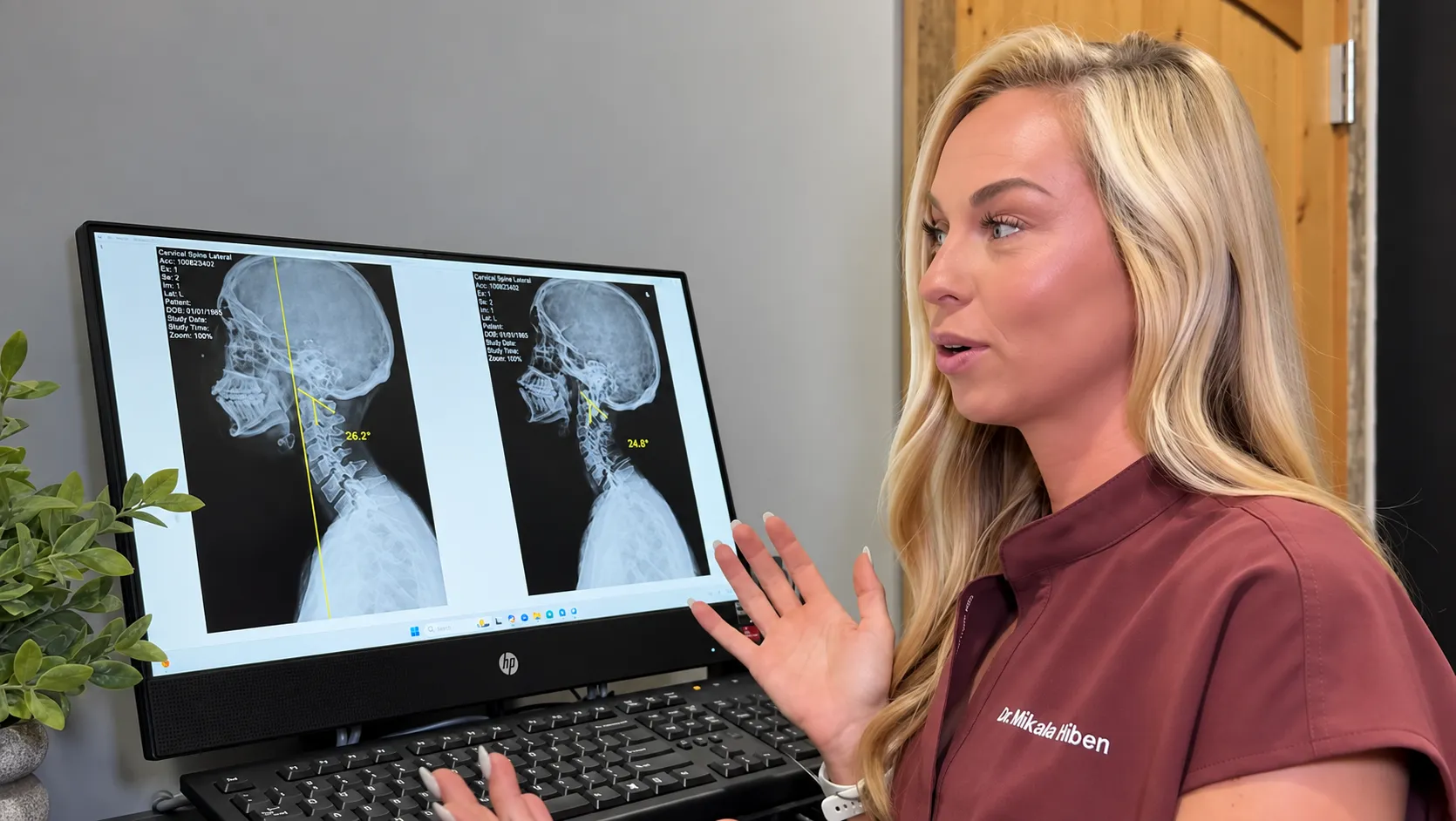
Digital X-rays can show alignment and spinal curve changes that aren't necessarily obvious from symptoms alone. They also provide a starting point that can be compared with later images as care progresses.
That gives Dr. Mikala Hiben, DC, something to compare as care continues, rather than relying on whether you happen to have a good pain day or a bad one.
How Can Bee Cave Chiropractic Care Confirm Healing?
Feeling less pain is encouraging, but it doesn't tell you everything about what has happened to your spine.
The next question is whether the changes seen after the accident are actually improving. X-rays taken at the beginning of care can be compared with images from later visits to see how the spine has changed. Pain may improve before the underlying structural changes have been addressed, so looking at the images gives Dr. Mikala Hiben, DC, another way to evaluate progress.
Instead of judging recovery by symptoms alone, the images can show where correction has occurred and where more work may be needed. They also help set realistic expectations, since some structural changes can take longer to improve even when you start feeling better.
Why Does Location Matter for Auto Injury Care?
After a crash, there is already plenty to deal with. Having care nearby makes it easier to get evaluated without adding another long trip to the list.
What Does Root-Cause Correction Actually Involve?
No two crashes put the same forces through the body, so the care plan shouldn't look exactly the same for everyone. The examination and imaging help determine what changed and what needs attention.
A corrective care plan may include targeted adjustments, progress imaging, and rehabilitation based on the patient's specific injury pattern. The focus is on addressing the structural changes from the collision rather than only managing the discomfort they cause.
For someone recovering from whiplash, that can mean looking at:
- What changed: What areas of the spine were affected by the collision?
- How things are progressing: Are later images showing measurable changes?
- What still needs attention: Has pain improved while movement or alignment issues remain?
Those findings shape what happens next. There isn't a standard series of adjustments that every auto injury patient simply moves through.
FAQ
How long after a car accident do whiplash symptoms appear?
There isn't a clock that says exactly when whiplash will start hurting. Some people notice neck pain or stiffness within a few hours, while others don't feel much until the next day or even a couple of days later. The 24 to 72 hour window is common, as inflammation and swelling around injured soft tissue build.
So don't assume you're in the clear just because your neck feels fine when you get home. Pay attention to how your neck, shoulders, and upper back feel over the next few days.
Why does my neck hurt the day after the accident instead of right away?
The impact itself happens instantly, but the inflammation that follows doesn't. As the injured tissue becomes more irritated and swollen, symptoms can become easier to notice.
This is why you might go to bed thinking you're fine and wake up with a neck that feels stiff, sore, or difficult to turn.
What should I look for if I don't have neck pain?
Don't focus only on pain. A change in how your body moves can be just as noticeable.
Watch for things such as:
- Having trouble turning your head from side to side
- Stiffness through your neck or upper back
- A headache that wasn't there before the accident
- Pain moving into your shoulders, shoulder blades, or jaw
- Dizziness, tingling, or weakness
I feel better after a few days. Do I still need to be concerned?
Feeling better is good. The question is whether the underlying changes have improved too. Symptoms and structural changes don't always move at the same pace.
That's one reason EWC uses digital X-rays as part of its evaluation and progress checks. Images taken at different points in care can be compared rather than using pain levels as the only measure of change.
When should I get checked after a car accident?
The first 24 to 72 hours, even when symptoms haven't fully appeared. An early assessment gives the chiropractor a chance to establish a baseline and evaluate what changed during the collision.
You don't have to wait until you can barely turn your head before getting it checked.
Can chiropractic care help with delayed whiplash symptoms?
Corrective chiropractic care is designed to address the structural changes associated with the injury rather than focusing only on temporary symptom relief. EWC's approach may include targeted adjustments, progress imaging, and rehabilitation based on the patient's specific injury pattern.
Conclusion: What to Do After a Car Accident
The hardest part about a delayed whiplash injury is that you may not have much to go on at first. Your car is damaged, the accident is behind you, and you may feel almost normal. You might feel fine that afternoon and wake up the next day with stiffness, a headache, or pain that wasn't there before. That delayed response is one reason it can be easy to underestimate a whiplash injury.
So if you walked away from a crash feeling fine, don't assume that settles the question. An evaluation can help identify what changed during the collision, while digital X-rays give Dr. Mikala Hiben, DC, a way to track those changes as care progresses.
For drivers in Bee Cave and southwest Austin, the next step doesn't have to be guessing whether that stiffness, headache, or limited neck movement will disappear on its own. Getting checked gives you somewhere to start, especially when you're not sure whether that stiffness or headache is simply going to disappear.

Dr. Mikala Hiben
Chiropractor and Owner at Elite Wellness Chiropractic
Featured Articles

10 Posture Tips for Residents of Bee Cave, Texas
Improve your posture with these 10 practical tips from Elite Wellness Chiropractic in Bee Cave. Simple daily changes for better spinal alignment and less pain.
10 Posture Tips for Residents of Bee Cave, Texas

What to Expect at Your First Chiropractic Visit in Bee Cave
Wondering what happens at your first chiropractic appointment? Here's a clear walkthrough of the consultation, exam, X-rays, costs, and how to prepare for your visit at Elite Wellness Chiropractic in Bee Cave.
What to Expect at Your First Chiropractic Visit in Bee Cave

Unlock Lasting Relief for Tech Neck: Beyond Temporary Fixes
Struggling with tech neck? Learn how corrective chiropractic care at Elite Wellness in Bee Cave can relieve neck pain, improve posture, and restore lasting comfort.
Unlock Lasting Relief for Tech Neck: Beyond Temporary Fixes